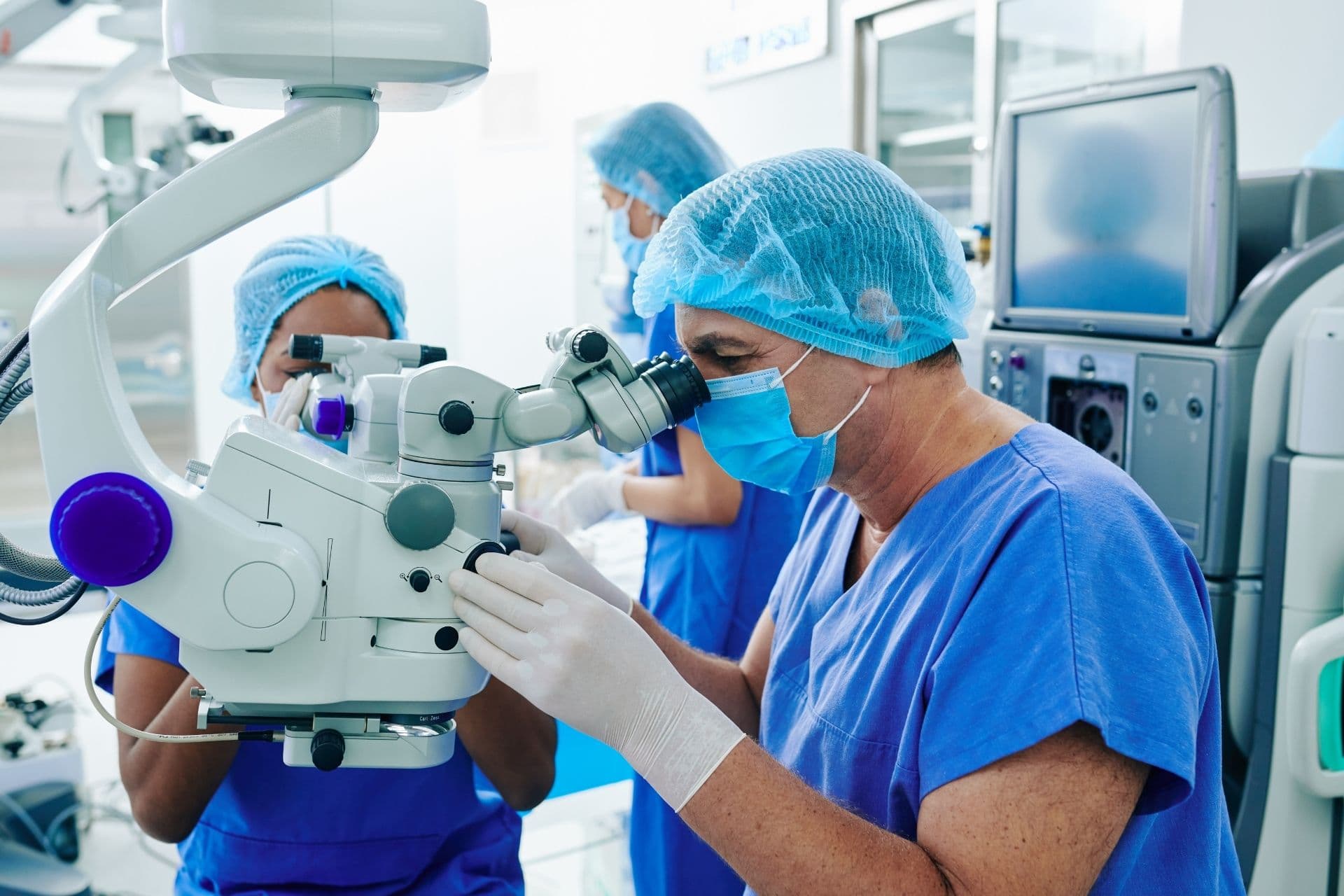
Lens replacement surgery — also called refractive lens exchange (RLE) — is one of the most significant elective investments a patient can make. At home in the UK, Germany, Switzerland or the Netherlands, bilateral surgery with premium multifocal lenses routinely costs between €10,000 and €22,000. The same procedure, performed by an equivalently trained surgeon using identical lens technology, costs from €2,980 for both eyes at Clear Sight Abroad in Prague.
That gap — often €8,000 to €17,000 — is real. It is not explained by lower quality, inferior equipment, or less experienced surgeons. It is explained by the economics of healthcare: lower staff wages, smaller facility overheads, and a different regulatory cost structure in Central Europe.
This guide gives you the numbers you need to make an informed decision. We compare surgery costs country by country, model the true cost of travelling to Prague (including flights, hotels and two visits), walk through four real patient savings calculations, and give you an honest answer to the question: when is it worth it — and when might it not be?
What does lens replacement surgery cost? A country-by-country comparison
The table below shows typical private-pay prices for refractive lens exchange (RLE) across Europe. These are real-world ranges based on published clinic pricing and patient reports as of Q1 2026 — not theoretical figures. Standard monofocal means you will still need reading glasses. Premium trifocal or EDOF lenses give you a wider focus range and near-independence from glasses.
| Country | Standard monofocal | Premium trifocal / EDOF | Bilateral (both eyes) |
|---|---|---|---|
| 🇨🇭 Switzerland | CHF 4,800–8,500 / eye | CHF 7,000–13,000 / eye | CHF 14,000–26,000 |
| 🇬🇧 United Kingdom | £4,200–7,500 / eye | £6,000–11,000 / eye | £12,000–22,000 |
| 🇩🇰 Denmark | €4,000–7,000 / eye | €5,500–9,500 / eye | €11,000–19,000 |
| 🇳🇱 Netherlands | €3,500–6,500 / eye | €5,000–8,500 / eye | €10,000–17,000 |
| 🇮🇪 Ireland | €3,800–6,500 / eye | €5,000–9,000 / eye | €10,000–18,000 |
| 🇩🇪 Germany | €3,200–5,500 / eye | €4,500–8,000 / eye | €9,000–16,000 |
| 🇦🇹 Austria | €2,800–5,000 / eye | €4,000–7,500 / eye | €8,000–15,000 |
| 🇨🇿 Prague – Clear Sight Abroad | from €1,490 / eye | from €1,490 / eye | from €2,980 |
Prices are estimates based on public clinic data, Q1 2026. Premium IOL pricing includes trifocal and EDOF lenses. Always request a personalised quote — your prescription and IOL choice will affect the final figure.
Why is Prague so much cheaper?
The price of surgery in any country is mostly a reflection of local costs — not of clinical quality. Three factors drive the gap:
1. Staff salaries
An ophthalmologist in Prague earns a competitive Czech salary — excellent by local standards, but roughly 40–55% of what a surgeon earns in London, Zurich or Copenhagen. The same applies to nurses, anaesthetists and clinic administrators. Labour is the largest cost in any surgical procedure.
2. Facility and rental costs
Premium clinic space in central Prague costs a fraction of equivalent space in Zurich, Amsterdam or central London. Capital equipment (laser systems, diagnostic devices, operating theatre fit-out) costs the same worldwide — it is the building and running costs that differ.
3. Regulatory and insurance overhead
Medical liability insurance, regulatory compliance and administrative burden in Western Europe are substantially higher than in the Czech Republic, even though both operate under EU medical device regulation for the implants themselves. Czech clinics carry appropriate liability coverage — but at lower premiums.
What is the real cost of going abroad?
Travelling to Prague for lens replacement typically requires two visits: a pre-operative assessment (same day if you fly in) and the surgery itself, which may span two days for bilateral procedures. Some clinics, including Clear Sight Abroad, can accommodate the initial consultation and one-eye surgery on day one, with the second eye on day two, meaning the full bilateral procedure can be done in a single trip of three to four days.
Typical travel costs (return trips from major European cities)
- ✓London → Prague: £80–£180 return (easyJet, Ryanair, British Airways). Flight time: 2 hours.
- ✓Frankfurt → Prague: €60–€140 return (Lufthansa, Eurowings). Flight time: 1 hour 10 minutes.
- ✓Zurich → Prague: CHF 90–€160 return (Swiss, Eurowings). Flight time: 1 hour 20 minutes.
- ✓Amsterdam → Prague: €70–€150 return (KLM, Wizz Air). Flight time: 1 hour 45 minutes.
- ✓Dublin → Prague: €80–€180 return (Ryanair). Flight time: 2 hours 20 minutes.
- ✓Copenhagen → Prague: €70–€160 return (SAS, Ryanair). Flight time: 1 hour 50 minutes.
A central Prague hotel comfortable enough for a medical stay (3–4★, city centre) costs €80–€150 per night. For two visits totalling four nights, budget €320–€600 for accommodation.
Total realistic travel budget for the full procedure: €400–€900 for most Western European patients. Some patients who live closer (Vienna, Munich, Berlin) will pay considerably less.
Real savings: four patient case studies
The calculations below model a patient in each country choosing bilateral surgery with a premium trifocal or EDOF intraocular lens. We have used the midpoint of typical home-country pricing and a realistic Prague package price (bilateral premium IOL, all-inclusive at Clear Sight Abroad).
Travel costs are estimates based on typical return economy fares and 3★ hotels for two visits (pre-op consultation + surgery). Savings are illustrative; your actual figures will depend on IOL choice, prescription and travel dates.
Is the quality genuinely comparable?
This is the most important question — and the answer is yes, when you choose the right clinic. Here is why.
Surgeon qualifications
Czech ophthalmologists complete the same European postgraduate training pathway as their Western counterparts. The benchmark qualification in European ophthalmology is the FEBO (Fellow of the European Board of Ophthalmology), awarded by the European Board of Ophthalmology after written and clinical examination. Surgeons at Clear Sight Abroad hold FEBO certification and have performed thousands of lens replacement procedures. Their training and examination standards are identical to a consultant at a UK NHS trust or a Belegarzt in Germany.
Diagnostic and surgical equipment
Modern refractive lens surgery requires the same diagnostic platform regardless of geography: optical coherence tomography (OCT), biometry for IOL power calculation (typically Zeiss IOLMaster or Haag-Streit Lenstar), and a phacoemulsification system for cataract/lens removal. Clear Sight Abroad uses current-generation equipment from the same manufacturers used in London, Zurich and Amsterdam clinics. There is no compromise on technology.
Outcomes data
The Czech Republic has been performing refractive and cataract surgery on international patients for over two decades. Published complication rates for phacoemulsification lens surgery at experienced Central European clinics are comparable to those reported in Western European literature — typically below 1% for posterior capsule rupture and below 0.1% for serious infectious complications (endophthalmitis) in high-volume settings.
Language and communication
Clear Sight Abroad operates entirely in English. All consultations, pre-operative assessments, surgical discussions and aftercare communications are in English. Written reports and imaging are provided in a format your home country doctor can interpret. You will never be left without a clear explanation of what is happening.
What can go wrong — and how to protect yourself
Lens replacement surgery carries the same risks whether performed in London or Prague. The most common issues are minor and manageable: dry eye in the first weeks, posterior capsule opacification (a secondary cloudiness that can appear months after surgery and is corrected with a 2-minute YAG laser procedure), and an adjustment period as the brain adapts to multifocal optics. Serious complications — retinal detachment, infection, significant refractive error — are rare at any quality clinic.
The specific risks of surgery abroad are different. They relate not to the surgery itself but to aftercare:
- ✓Follow-up visits: You will need a 1-day post-operative check (typically done before you fly home), a 1-week check (can be done at your local GP or optometrist), and a 1-month check. Clear Sight Abroad coordinates this and provides written protocols your home clinician can follow.
- ✓Complications at home: In the unlikely event of a serious complication after returning home, you will be treated by your local emergency eye service. Clear Sight Abroad provides a 24-hour contact line and full surgical notes for any emergency presentation.
- ✓YAG laser (if needed): Posterior capsule opacification, if it develops, requires a YAG laser treatment. This can be done by any ophthalmologist worldwide. Clear Sight Abroad can also arrange it on a return visit at no charge.
- ✓Travel after surgery: Most patients fly home the day after the final eye is operated on. Modern air cabins are dry, which can aggravate post-operative dry eye. Use preservative-free lubricant drops throughout the flight.
When going abroad is worth it — and when it might not be
It is clearly worth it when:
- ✓You are having bilateral surgery (both eyes). The savings scale with the number of eyes — for one eye only, the calculation is tighter.
- ✓You want premium multifocal or EDOF lenses. Premium IOL pricing in Western Europe is where the gap is largest. If you are choosing a standard monofocal lens, you can still save significantly, but the absolute figure is smaller.
- ✓You are otherwise healthy and can travel without complications. The process involves two short flights and a few nights in a city hotel — straightforward for most people aged 45–75.
- ✓You are patient and organised. Going abroad requires scheduling, paperwork and planning. The reward is €6,000–€17,000 in savings.
Think carefully if:
- ✓You have complex ocular co-morbidities (advanced glaucoma, significant corneal disease, previous complex retinal surgery) that may require very specific local expertise and frequent follow-up.
- ✓Your eyesight is deteriorating rapidly or you need surgery urgently — international scheduling takes longer than a local booking.
- ✓You are not comfortable flying or have a health condition that makes air travel inadvisable.
- ✓You are only correcting one eye and the home-country price difference for a monofocal lens is small enough that the hassle is not justified.
Why Prague specifically?
Prague is not the only option for eye surgery abroad — clinics in Hungary, Poland and Spain also attract international patients. Prague has specific advantages that make it the preferred choice for most Western and Northern European patients:
- ✓Direct flights from every major European hub. London, Dublin, Zurich, Frankfurt, Amsterdam, Copenhagen, Vienna — all have multiple daily direct services to Václav Havel Airport. The city is at the geographic centre of Europe.
- ✓EU membership and medical device regulation. Czech Republic has been an EU member since 2004. All intraocular lenses used must be CE-marked under the EU Medical Device Regulation (MDR). The regulatory framework is identical to Germany, France or the Netherlands.
- ✓Established infrastructure for international patients. Prague has been receiving medical tourists for over 20 years. Clinics are experienced with international logistics: transfers, translators, documentation, insurance paperwork.
- ✓Cost of living keeps everything cheaper. Not just the surgery — your hotel, meals and transport are all 40–60% cheaper than in London, Amsterdam or Zurich. Your trip to Prague costs less than staying in a city hotel at home.
- ✓Safety and comfort. Prague is consistently rated among Europe's safest cities. Central Prague's hotels and restaurants offer excellent quality. Patients frequently comment that the overall experience — from arrival to departure — is smoother than expected.
Frequently asked questions
Is lens replacement surgery abroad really as safe as at home?+
When you choose an accredited clinic with FEBO-certified surgeons and current-generation equipment, the clinical safety profile is comparable to Western European private clinics. The surgical technique, IOL technology and monitoring protocols are identical. The difference lies in aftercare logistics — you will need to coordinate follow-up with your home GP or optometrist — but this is straightforward and well-supported by quality international clinics.
How many trips to Prague do I need?+
Typically two visits. The first is a pre-operative consultation (can be done on the same day you arrive; results are shared digitally in advance to minimise surprises). The second is the surgery itself, which for bilateral procedures takes two consecutive days — meaning a total stay of 3–4 nights. Some patients combine both into a single extended trip. Clear Sight Abroad's coordinator will design the most efficient schedule for your travel pattern.
What is included in the price at Clear Sight Abroad?+
The all-inclusive price covers the pre-operative biometry and assessment, the surgical procedure for both eyes, the intraocular lens itself (including premium trifocal or EDOF options), the 1-day post-operative check, all follow-up consultations during your stay, and written documentation for your home ophthalmologist. There are no hidden fees for anaesthesia, facility use or standard medications.
Can I get my follow-up care at home after surgery in Prague?+
Yes, and this is the standard pathway. Clear Sight Abroad provides detailed surgical notes and a follow-up protocol for your GP or local optometrist. The 1-day check is done before you fly home. The 1-week check can be performed by any optometrist or GP with a slit lamp. The 1-month check is ideally done by an ophthalmologist; if you prefer, you can return to Prague for this at no additional clinical charge (you cover your own travel).
What if something goes wrong after I return home?+
Serious complications from lens replacement surgery are rare — below 0.5% at experienced clinics. If a complication does occur, present to your nearest emergency eye service and call Clear Sight Abroad's 24-hour contact line. The clinic will communicate with your treating team directly and arrange any necessary return visit. Clinics that work with international patients are experienced with exactly this scenario.
Does my home-country health insurance cover surgery abroad?+
Standard national health insurance (NHS, GKV, Krankenkasse) does not typically cover elective refractive procedures at home or abroad. Private health insurance varies: some policies cover elective eye surgery abroad, particularly under EU portability rules; others do not. Check your policy before booking. What most insurers will cover is emergency treatment abroad if a complication arises — ensure your travel insurance is in place.
Is the lens I get in Prague the same as the lens available at home?+
Yes. Premium intraocular lenses from ZEISS (AT LISA tri, AT LARA), Alcon (PanOptix, Vivity) and Johnson & Johnson (Tecnis Synergy, Symfony) are manufactured and CE-marked to the same standard globally. Clear Sight Abroad uses the same lens platforms available in London, Zurich or Amsterdam private clinics — at a substantially lower total cost.
How do I choose the right IOL for me?+
The IOL recommendation is based on your biometry measurements (eye length and corneal curvature), your prescription, your lifestyle and your visual priorities. At your pre-operative consultation in Prague, your surgeon will explain the full range of options — monofocal, extended-depth-of-focus (EDOF) and trifocal — and recommend the lens that best suits your eyes and daily life. There is no obligation to choose the most expensive option.
Ready to find out if you qualify?
Send us your details for a free online consultation. Our English-speaking team will respond within 24 hours.